I’ve been telling impact stories since 2014. And in spite of all the experience, it still takes lot of effort to get it right. Every single time.
Whether you are a nonprofit, foundation, CSR or a social enterprise, on one hand you need to tell stories that are emotionally powerful. And on the other hand, you also cannot afford to oversimplify people’s lives, exaggerating your contribution. Definitely not reduce beneficiaries to victims.
In this blog, I am sharing some do’s and don’ts that have worked for me and my team over the years with respect to social impact storytelling.
–Amrit, Founder, 3MinuteStories.com (a Story99 social impact venture)
Table of Contents
- Do – Anchor the story around one person when you can
- Don’t – Make the Beneficiary Helpless So Your Organisation Can Look Heroic
- Do – Show What Actually Changed
- Don’t – Manufacture a Dramatic Transformation
- Do – Combine Stories With Evidence
- Don’t – Turn People Into Mere Statistics
- Do – Preserve Complexity
- Don’t – Use Suffering as the Only Source of Emotion
- Do – Get Meaningful Consent
- Don’t – Forget the System Behind the Story
- A Practical Social Impact Storytelling Framework
- The Golden Rule of Social Impact Storytelling
- FAQs – Frequently Asked Questions – About Social Impact Storytelling
1. Do – Anchor the story around one person when you can
Such stories are easier to follow. For example, the video story above is ultimately about an IIT Professor who decided to do something for the village where he grew up. Coincidentally, my own mother grew up in a nearby place in the same region (Darbhanga, Bihar). Also, I had seen Prof Sreesh during my undergrad days (IIT Madras) but never got a chance to take any of his classes (he taught English in the Dept of Humanities).
Anyway, the point that I wanted to make is this: when social impact storytelling starts with an individual, their experience makes it easy for us to understand a much larger issue, without getting lost.
2. Don’t – Make the beneficiary helpless so that your organisation can look heroic
One of the easiest storytelling shortcuts is also one of the most damaging: Person was helpless → organisation arrived → person’s life changed.
Real life is rarely that simple. People experiencing poverty, disability, unemployment, limited educational opportunities or other social challenges still have agency, ambitions, skills, families and communities. Thus storytelling should put the constituent first rather than treating their experience primarily as a fundraising device.
For example, instead of ‘without our intervention, Sunita had no hope’, you can try something like ‘Sunita had been trying to expand her tailoring business for two years. What she lacked was access to affordable working capital’.
Your organisation obviously matters in the story that you tell. But it typically make sense to position it as an enabler of change rather than the hero of somebody else’s life.
3. Do – Show what actually changed
A common mistake in impact communication is confusing activity with impact.
For example, “we conducted 42 workshops for 1,600 students” tells the reader what you did.
But what the world is usually more interested in is what happened because you did it?
- Did behaviour change?
- Did knowledge increase?
- Did income rise?
The basic impact storytelling structure can be surprisingly simple: Person → Problem → Intervention → Observable change → What happens next
Your programme should occupy only one part of this journey.
4. Don’t – “Manufacture” a dramatic transformation
The fact is that not every social intervention creates a “movie-ending” transformation.
Sometimes the real outcome could sound modest:
- A student became clearer about three possible careers
- A farmer reduces fertiliser use by 15% (saving the family money and helping with better yeild)
- A woman opens her first bank account
And that’s ok. People care about honesty. They get it. Each of these can still be powerful stories. All you need is help with great ‘storytelling’ – without overblowing the story itself.
The temptation to turn every case study into “Everything changed overnight” may feel “powerful” to read in the short term, but ultimately, it weakens credibility. At the end of the day, specific, believable progress is usually more persuasive than exaggerated transformation.
5. Do – Combine stories with evidence
The strongest social impact storytelling sits at the intersection of human experience and evidence. And the above work that we did for iDC’s PathShila program is a great example that illustrates this.
A useful pattern is: One person → One change → Evidence that this change is happening at scale
For example: “Aarav was one of 74 students in his school who completed the programme. Three months later, 68% of participating students reported greater clarity about their post-school options.”
The individual makes the impact understandable. While the data shows that the individual is not an isolated anecdote. And this combination is particularly important when communicating with institutional audiences such as funders, CSR leaders, government partners and foundations.
6. Don’t – Turn people into mere statistics
A visual like this may seem familiar.
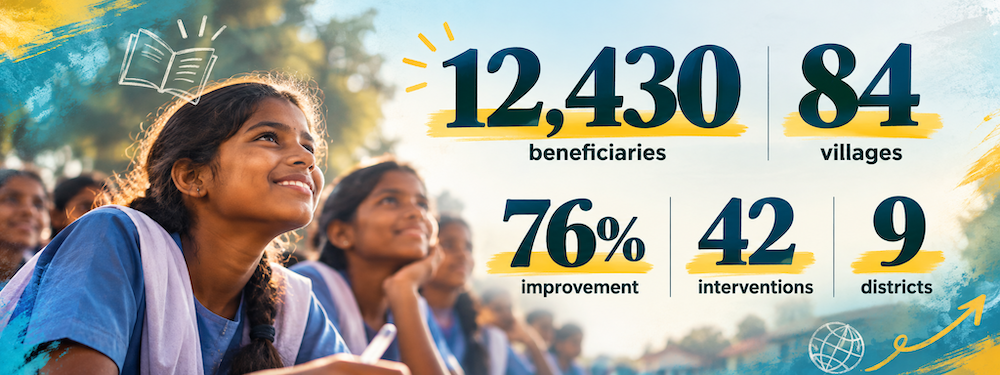
The numbers may be impressive, but the thing is, without context the audience has no intuitive sense of what they mean.
So always try asking: what do numbers look like in someone’s life? For example, instead of only saying, ‘81% of students created a career plan’, you can perhaps also try showing what one of those plans enabled a student to do differently.
Good social impact storytelling moves between the unit of one and the scale of thousands.
7. Do – Preserve Complexity
Impact stories often become weaker when communicators try too hard to ‘clean up’ the narrative.
A farmer rarely has one problem. A student’s career decision is rarely determined by one workshop. A woman starting a business may simultaneously be influenced by training, family support, access to credit, government schemes and her own persistence.
Now I am not suggesting you need to explain every variable. But at least don’t say ‘our programme changed her life’ when the more accurate statement could be: ‘the programme helped remove one of the barriers preventing her from growing her business’. That’s what I mean when I say – preserve complexity. It might sound paradoxical, but when you acknowledge complexity, it actually makes your organisation / the work that you do, sound more credible. Not less.
8. Don’t – Use suffering as the only source of emotion
Social impact storytelling often relies heavily on hardship: poverty, illness, exclusion, discrimination, trauma or loss. And I am not saying that these realities should be hidden. But suffering is not the only emotion available to a storyteller.
It is harder but definitely possible to build compelling impact stories around things like – ambition, pride, humour, determination, curiosity, relief, independence, belonging or possibility. I encourage you to watch the below documentary film I made many years ago – you will get the point.
9. Do – Get meaningful consent
Here is a sample consent form that you can modify for your use-case.
But it’s important for me highlight that consent in social impact storytelling should mean more than obtaining a signature. The person sharing their story should understand:
- what information is being recorded;
- where the story or photograph may appear;
- who might see it;
- whether their real name will be used;
- whether sensitive information will be included;
- and, where practical, whether they can change their mind.
And it’s your job to ensure that participants understand their rights and the possible implications of sharing their story. This becomes especially important when working with children, survivors of trauma or abuse, vulnerable communities and people whose participation in a programme could reveal sensitive information. And sometimes, the most ethical storytelling decision is not telling the story at all.
10. Don’t – Forget the system behind the story
Individual stories are powerful, but social impact is rarely produced by individuals alone. Behind one successful outcome there may be: teachers, counsellors, frontline workers, programme managers, government officials, community organisations, donors, technology and years of institutional learning.
Good storytelling uses an individual story as the entry point. And then shows the system that made change possible. This is particularly useful for organisations trying to communicate not just that their intervention works, but why it can scale.
A Practical Social Impact Storytelling Framework
Before publishing any impact story (be it a documentary or in a newsletter or a post on Linkedin), answer five questions:
1. Who is the story about?
Identify the person experiencing the change.
2. What did they want?
Give them an aspiration, not merely a problem.
3. What stood in their way?
Explain the barrier clearly.
4. What changed?
Show the specific role played by the intervention.
5. What evidence tells us this matters beyond one individual?
Connect the story to programme-level or system-level evidence.
The resulting narrative becomes:
Person → Aspiration → Barrier → Intervention → Change → Evidence
It is simple enough for a social-media post and robust enough for a film, annual report (or even a fundraising presentation).
The Golden Rule of Social Impact Storytelling
I think if there is one principle worth remembering, it is this: the person whose story you are telling should remain the protagonist. Your organisation should be part of their story – not the other way around.
This outlook will affect the photographs you select, the questions you ask during interviews, the claims you make about impact and even the way you describe the people your organisation works with.
Stanford Social Innovation Review has long argued that effective social-impact communication requires organisations to think deliberately about both narrative and the networks through which stories travel. And that means great social impact storytelling needs to do more than merely make people feel something. It should also help them understand who changed, what changed, why it changed and what role your organisation genuinely played in making that change possible.
Frequently Asked Questions (FAQ) About Social Impact Storytelling
What is social impact storytelling?
Social impact storytelling is the use of human stories, evidence and narrative to explain how a programme, organisation or intervention creates social change. It is commonly used by nonprofits, CSR teams, foundations, social enterprises and development organisations.
What makes a good impact story?
A good impact story has a clear protagonist, an aspiration or challenge, a specific intervention and an observable change. The strongest stories also connect an individual experience with credible evidence showing broader impact.
What is ethical storytelling in the social sector?
Ethical storytelling means communicating people’s experiences while protecting their dignity, agency, privacy and right to informed consent. The needs of the organisation or donor should not automatically take priority over the interests of the person whose story is being shared.
Should impact stories include statistics?
Yes. Human stories create understanding and emotional connection, while statistics provide evidence of scale. The strongest impact communication generally combines both.
What should nonprofits avoid when telling impact stories?
Nonprofits should avoid portraying beneficiaries as helpless, exaggerating their organisation’s contribution, using trauma purely to create emotion, publishing stories without meaningful consent and presenting activities as evidence of impact.
How do you structure a social impact story?
A useful structure is: Person → Aspiration → Barrier → Intervention → Change → Evidence
This usually works across case studies, social-media content, fundraising presentations, impact reports and documentary films.
About the Author
Amrit Vatsa is the founder film-maker at 3MinuteStories (3MS) – a short documentary film-making venture working with CSR, non-profits and others to bring out impact stories and stories of change. 3MS is the social impact arm of Story99 – a storytelling consultancy for B2B, Tech & Deeptech.